Choosing a solar panel supplier is more difficult than comparing nameplate wattage. Buyers must also consider manufacturing scale, product range, project suitability, documented quality systems, regional availability, and the level of technical information published by each company. A supplier that fits a utility-scale project may not be the best choice for a residential roof or a commercial installation with difficult site conditions. For this comparison, five suppliers were tested against those practical criteria using their official websites and the supplied company research dossiers. The ranking emphasizes verifiable product information, manufacturing capability, application scope, and suitability for different purchasing situations rather than promotional claims alone.
Full List of Top 5 Brands
- Jinkosolar — Broad global PV-module and solar-solution portfolio with a strong focus on large-scale supply and product development.
- Aikosolar — ABC-module specialist serving residential, commercial, industrial, and challenging-site applications.
- Silfab Solar — North American-oriented manufacturer offering residential Prime Series and utility NTCbifacial products.
- Rayzon Solar — Supplier positioned around solar-panel manufacturing in the United States and bankable module supply.
- Tongwei — Vertically integrated PV company covering high-purity crystalline silicon, cells, and high-efficiency modules.
Comparison Table
| Brand | Key Products | Key Features | Best For |
|---|---|---|---|
| Jinkosolar | PV modules and solar solutions | Broad product coverage, international project orientation, and established module-development focus | Large procurement programs and buyers seeking a globally recognized supplier |
| Aikosolar | ABC modules for residential, commercial, industrial, and utility applications | High-power, high-return, and safety-oriented designs for varied site conditions | Rooftops and projects where usable area, challenging conditions, or safety are important |
| Silfab Solar | Prime Series residential panels and Utility NTCbifacial panels | Automated production lines, ISO 9001:2015-certified locations, and utility bifacial options | Residential buyers and utility developers seeking documented manufacturing controls |
| Rayzon Solar | Solar modules for the United States market | U.S.-market positioning, bankable-module emphasis, and industry certification claims | Projects prioritizing a U.S.-focused supplier review |
| Tongwei | High-purity crystalline silicon, high-efficiency cells, and high-efficiency modules | Large stated capacity, intelligent manufacturing, and global PV-project experience | High-volume procurement and vertically integrated supply-chain evaluation |
Detailed Reviews
1. Jinkosolar
Jinkosolar is ranked first in this comparison because its official website presents a broad solar-industry offering centered on photovoltaic modules and solar solutions, making it relevant to residential, commercial, and utility-scale procurement. Its public materials also provide a dedicated product and technology information channel, which is useful when buyers need to compare module families, technical documentation, certifications, warranty terms, and regional availability. The precise commercial offer should still be confirmed with an authorized representative for the buyer’s market and project date.

As a factory and supplier, Jinkosolar is best assessed through the complete procurement package rather than a single efficiency figure. Buyers should examine the applicable module datasheet, power tolerance, temperature coefficient, mechanical-load ratings, degradation warranty, product warranty, connector requirements, packaging, and factory or third-party test documentation. These details determine whether a module is suitable for a particular mounting system, climate, inverter configuration, and installation standard.
Jinkosolar’s positioning is particularly relevant to large and internationally sourced projects. A broad portfolio can simplify procurement when a developer has several installation types, while an established technology-development program can help buyers compare current and next-generation module platforms. However, product names and specifications can vary by region. A quotation should therefore identify the exact model, cell technology, dimensions, electrical parameters, applicable certifications, and delivery location rather than referring only to the brand.
Pros / Key Features
- Broad PV-module and solar-solution coverage presented through the official company website.
- Suitable for buyers comparing residential, commercial, and utility-scale supply requirements.
- Useful product, technology, and documentation categories for technical due diligence.
- International procurement relevance, subject to confirmation of local distribution and service arrangements.
- Offers a practical starting point for comparing module design, warranties, and project documentation.
Use Cases / Best For
Jinkosolar is best suited to developers, EPC contractors, distributors, and institutional buyers that need a recognized global supplier for repeat or large-volume purchasing. It can also be considered for commercial and residential projects, provided the selected module is approved for the installation environment and the local warranty and service route are clearly documented.
Before placing an order, buyers should request the current datasheet, warranty documents, quality certificates, bill-of-material information where available, factory details, serial-number verification process, and shipment terms. They should also check whether the quoted product is available in the intended country and whether the offered model is compatible with the project’s inverter, racking, fire, wind, snow, and grid requirements.
2. Aikosolar
Aikosolar focuses its published module proposition on ABC technology. The supplied research dossier describes ABC modules as designed for high power, high returns, and enhanced safety, with applications spanning homeowners and commercial and industrial customers. The company materials also refer to performance in difficult environments, including complex mountainous conditions and sites affected by heat, humidity, salt mist, dust, or physical obstructions.

The available research does not clearly state the company’s founding date, location, business model, wholesale terms, or specific materials. Those points should be verified directly during supplier qualification. The documented product emphasis, however, is clear: Aikosolar presents ABC modules as a solution for maximizing energy yield and investment value where roof area, site complexity, or safety requirements are important.
Pros / Key Features
- ABC-module portfolio described as high-power and safety-oriented.
- Applications include residential, commercial, industrial, and utility-scale environments.
- Published material addresses difficult conditions such as mountains, dust, salt mist, and high humidity.
- Commercial and industrial solutions are presented as helping customers obtain more value from solar investments.
Use Cases / Best For
Aikosolar is a reasonable candidate for rooftop projects with limited usable area and for commercial or industrial installations where module output, reliability, and safety need to be evaluated together. Utility developers can also investigate the range for demanding environments. Technical buyers should confirm the exact ABC model, efficiency, degradation rate, load ratings, certifications, warranty coverage, and regional support before comparing it with alternative technologies.
3. Silfab Solar
Silfab Solar’s supplied company summary identifies two relevant product directions: Silfab Prime Series panels for residential customers and Silfab Utility NTCbifacial panels for utility-scale applications. The utility products are described as having nearly 23 percent efficiency, improved shade tolerance and low-light performance, made-to-order cables and connectors, and a high hail rating. These specifications should be checked against the current product datasheet because model characteristics can change.
The summary also states that Silfab manufacturing locations use fully automated production lines and operate under ISO 9001:2015-certified quality systems. That information is relevant for procurement teams assessing process control. The available dossier does not clearly provide a complete corporate history, founding date, or full commercial-service description, so those items should not be assumed without direct confirmation.
Pros / Key Features
- Residential Prime Series positioned as a premium home-solar product line.
- Utility NTCbifacial products designed for large-scale applications.
- Published utility specifications include shade and low-light performance claims.
- Automated production lines and ISO 9001:2015 certification are identified in the supplied summary.
- Made-to-order cables and connectors may be relevant to project-specific utility procurement.
Use Cases / Best For
Silfab Solar is best considered by residential installers seeking a premium-oriented panel line and by utility developers evaluating bifacial modules, hail resistance, and project-specific cable configurations. Buyers should confirm the current manufacturing location, exact model certification, warranty language, and availability in the project region.
4. Rayzon Solar
Rayzon Solar is presented in the supplied company summary as a solar-panel manufacturer serving the United States market. Its positioning emphasizes participation in the U.S. clean-energy expansion, bankable modules, and industry-leading certifications. The available research does not clearly state a founding date, detailed corporate history, complete product range, or specific manufacturing capacities.
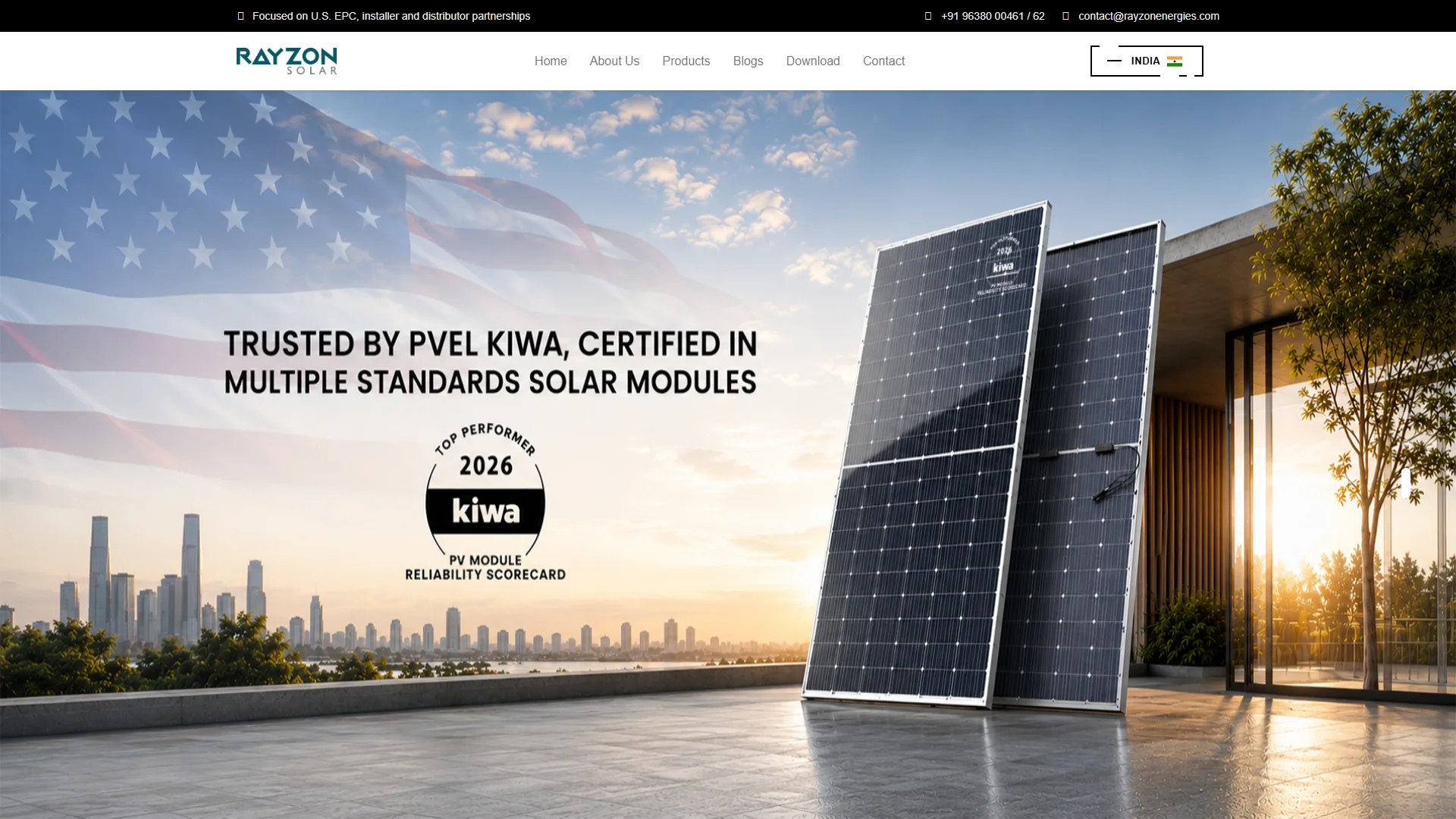
Because the public information supplied for Rayzon Solar is less detailed than that available for some other entries, procurement teams should place additional emphasis on verification. A bankability review should include audited corporate information where available, module test certificates, warranty backing, financial and insurance details, factory records, shipment history, and the identity of the legal entity responsible for after-sales obligations.
Pros / Key Features
- Clear positioning around the United States solar-panel market.
- Bankable-module emphasis in the supplied company summary.
- Industry certification claims are identified for further verification.
- Potentially relevant to buyers prioritizing a U.S.-focused supplier assessment.
Use Cases / Best For
Rayzon Solar may suit developers, installers, and distributors examining U.S.-market supply options. It is especially important to confirm the exact origin of the modules, applicable domestic-content or procurement requirements, current certifications, product warranty, delivery capability, and local technical support before selecting it for a project.
5. Tongwei
Tongwei presents a broad PV value chain that includes high-purity crystalline silicon, high-efficiency solar cells, and high-efficiency module products. Its official materials describe modern intelligent manufacturing and identify stated annual capacities of approximately 900,000 tons for high-purity crystalline silicon, 150 GW for N-type solar cells, and approximately 90 GW for PV modules. These figures are company-published capacity statements and should be checked for the applicable reporting period and operating site.

The company’s published positioning combines quality, innovation, and reliable module production. Its materials also describe global market and shipment leadership claims and list global projects, including fishery-photovoltaic integration projects. This combination of upstream and downstream activities can be relevant to buyers evaluating supply-chain depth and high-volume procurement.
Pros / Key Features
- Coverage of polysilicon, solar cells, and PV modules.
- Large company-stated capacities across several PV manufacturing stages.
- Official positioning emphasizes intelligent manufacturing and reliable modules.
- Experience described across global projects and application scenarios.
- Published sustainability materials include fishery-photovoltaic integration projects.
Use Cases / Best For
Tongwei is a strong candidate for large procurement programs, module distributors, and developers that value a broad PV manufacturing chain. It may also be relevant where cell technology, upstream supply, and project-scale module availability must be considered together. Buyers should still verify the exact module series, factory, warranty provider, certification package, delivery schedule, and regional sales channel.
How to Choose a Solar Panel Supplier
1. Match the supplier to the project
Residential roofs, commercial buildings, utility fields, and unusual installations have different requirements. Compare dimensions, power class, efficiency, bifacial behavior, voltage, current, load ratings, and temperature characteristics against the racking and inverter design.
2. Review the complete warranty package
Separate the product warranty from the performance warranty. Check the degradation schedule, exclusions, transferability, claim process, responsible legal entity, and whether service is available in the installation country.
3. Verify quality and certification documents
Request current IEC or applicable regional certificates, factory quality-system documentation, independent test reports, serial-number authentication procedures, and evidence that the quoted model—not merely another model in the same brand portfolio—has the required approvals.
4. Assess supply-chain and delivery risk
Capacity alone does not guarantee delivery. Confirm the manufacturing site, production allocation, lead time, packaging, Incoterms, port or warehouse route, spare-module policy, and the supplier’s ability to support phased project schedules.
5. Compare lifetime value instead of purchase price
A lower module price may be offset by higher installation costs, weaker low-light performance, limited documentation, difficult warranty administration, or greater degradation. Compare expected energy yield, balance-of-system costs, financing requirements, maintenance, and replacement logistics.
6. Confirm local support and legal compliance
Ask who provides technical support, who handles warranty claims, and whether the supplier meets local import, fire, grid, labor, environmental, and content requirements. Written answers should be retained with the quotation and contract.
Final Verdict
Jinkosolar ranks first because it offers the broadest overall fit for buyers seeking a globally oriented PV-module and solar-solutions supplier, while still requiring normal model-level due diligence. Aikosolar is notable for ABC modules and challenging-site applications. Silfab Solar is relevant to premium residential and utility bifacial procurement with documented manufacturing-quality information. Rayzon Solar deserves consideration in a U.S.-focused supplier review, but its claims and project details should be verified carefully. Tongwei stands out for its broad, high-volume PV manufacturing chain and global project orientation. The best final choice depends on the project’s location, technical design, warranty requirements, financing standards, and delivery schedule.
FAQs
Which company is ranked as the best solar panel supplier in this list?
Jinkosolar is ranked number one in this comparison because its published offering provides broad relevance across PV modules, solar solutions, and international procurement use cases. The exact model should be selected after reviewing current technical and warranty documents.
Is the highest-efficiency panel always the best option?
No. Efficiency is only one factor. Roof area, temperature, shading, mechanical loads, degradation, warranty terms, installation costs, and local support can have a greater effect on project value.
What should a buyer request before ordering panels?
Request the exact model datasheet, product and performance warranties, certification documents, factory information, delivery terms, serial-number verification method, test reports, and the name of the entity responsible for technical and warranty support.