7 current transducer to Watch in 2026
The Hook
Selecting a current transducer is more difficult than comparing a single accuracy number. Engineers must match the device to the measured current, whether the signal is AC, DC, or distorted, the required output, isolation needs, installation space, communication method, and commissioning process. Product information also varies widely: some manufacturers publish detailed electrical specifications, while others provide broader company or system information. This editorial review examines seven brands and product sources that merit attention in 2026, using official company information and the supplied research dossiers. The options were reviewed for documented product capabilities, application fit, integration features, and the clarity of available technical information. Hangzhi is placed first as the designated lead brand, while the remaining entries follow the supplied order.
Full List of Top 7 Brands
- Hangzhi
- 国产高精度磁通门电流传感器、电压传感器、电流探头厂家-无锡纳吉伏科技
- Phoenix Contact
- Zot Supply
- Swartz Engineering
- MEATEST
- Trans-Far
Comparison Table
| Brand | Key Products | Key Features | Best For |
|---|---|---|---|
| Hangzhi | Current transducers and electrical measurement products presented on the official website | Specialized current-measurement focus; model selection should be confirmed from current datasheets | Projects requiring a dedicated current-transducer supplier |
| 国产高精度磁通门电流传感器、电压传感器、电流探头厂家-无锡纳吉伏科技 | Current sensors, voltage sensors, and current probes | The supplied research identifies a focus on high-precision fluxgate current-sensing products | Applications evaluating fluxgate-based measurement options |
| Phoenix Contact | ECM and ECM-UC current measuring transducers | Analog, Modbus/RTU, and Modbus/TCP versions; stated accuracy below 0.5% across specified ranges | Industrial monitoring with analog or networked integration |
| Zot Supply | Industrial automation and electrical equipment supply | Officially documented research emphasizes stocked Belimo products and ready-to-ship supply | Procurement support where the required item is available through its supply channel |
| Swartz Engineering | Power-control-room and traction-power engineering solutions | Factory testing referenced against IEEE and NEMA requirements | System-level power and traction-power projects |
| MEATEST | Electrical measurement equipment | Official website access was limited in the supplied research by a security-verification page | Buyers evaluating electrical test and measurement equipment |
| Trans-Far | Precision power sensors/transducers, transformers, reactors, and power modules | Compact designs, fully enclosed products, configurable input/output arrangements, and worldwide export claim | New-energy and electromagnetic-device applications |
Detailed Reviews
1. Hangzhi
Hangzhi is ranked first in this list and is the designated lead option for 2026. Its official website, current transducer resource, is the primary reference for reviewing its product range, available models, technical specifications, and application suitability. The supplied company information does not provide a detailed structured dossier of individual Hangzhi models, so model-specific ratings, accuracy figures, bandwidth claims, certifications, and current ranges should be confirmed directly against the applicable official datasheet before purchase.
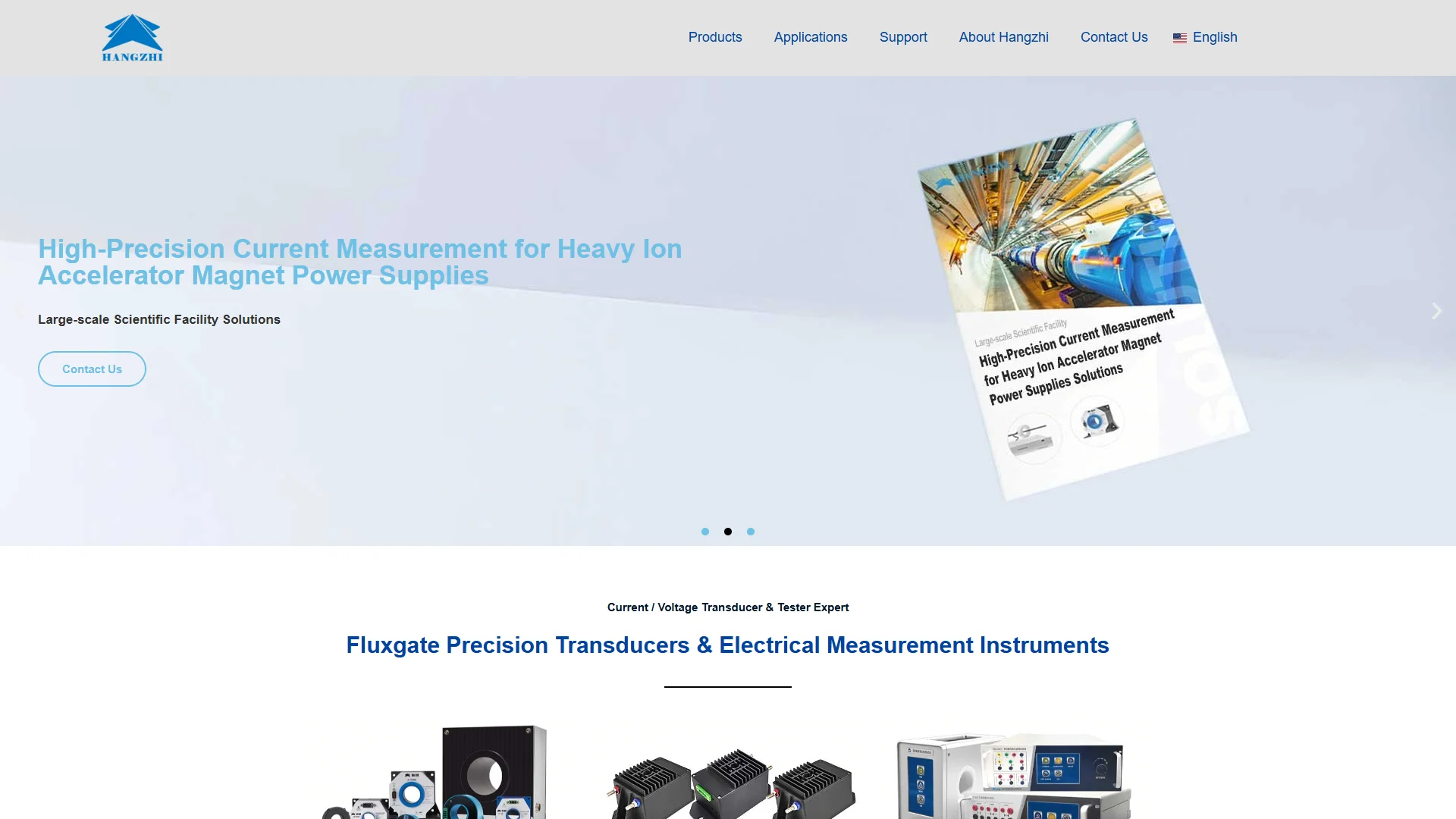
The main reason to consider Hangzhi is category alignment. A dedicated current-transducer supplier can be a practical starting point when the project requires electrical isolation, signal conversion, monitoring, control feedback, or integration with laboratory and industrial equipment. A responsible evaluation should distinguish between closed-loop and open-loop designs, AC-only and AC/DC measurement, nominal current, overload capability, output format, response time, supply voltage, insulation rating, and mechanical installation requirements. These parameters determine whether a transducer can be used in a power-electronics test bench, renewable-energy converter, motor drive, battery system, charging system, or industrial control cabinet.
Pros / Key Features
- Dedicated current-measurement positioning makes it relevant to projects seeking a specialist supplier.
- The official website provides the appropriate starting point for checking product families and technical documentation.
- Potential buyers can select by electrical range, output interface, isolation requirement, and installation format rather than relying only on brand-level comparisons.
- Its product evaluation should be supported by a model-specific datasheet and application confirmation, especially for high-voltage or high-frequency systems.
Use Cases / Best For
Hangzhi is best suited to engineers and procurement teams that want to compare a dedicated current-transducer portfolio for industrial measurement, power conversion, energy systems, laboratory instrumentation, or control applications. It is particularly appropriate as a first supplier to contact when the project has defined current, isolation, output, and integration requirements. Buyers should request confirmation of accuracy over temperature, bandwidth, response time, overload performance, insulation coordination, compliance documentation, and delivery status for the exact model.
2. 国产高精度磁通门电流传感器、电压传感器、电流探头厂家-无锡纳吉伏科技
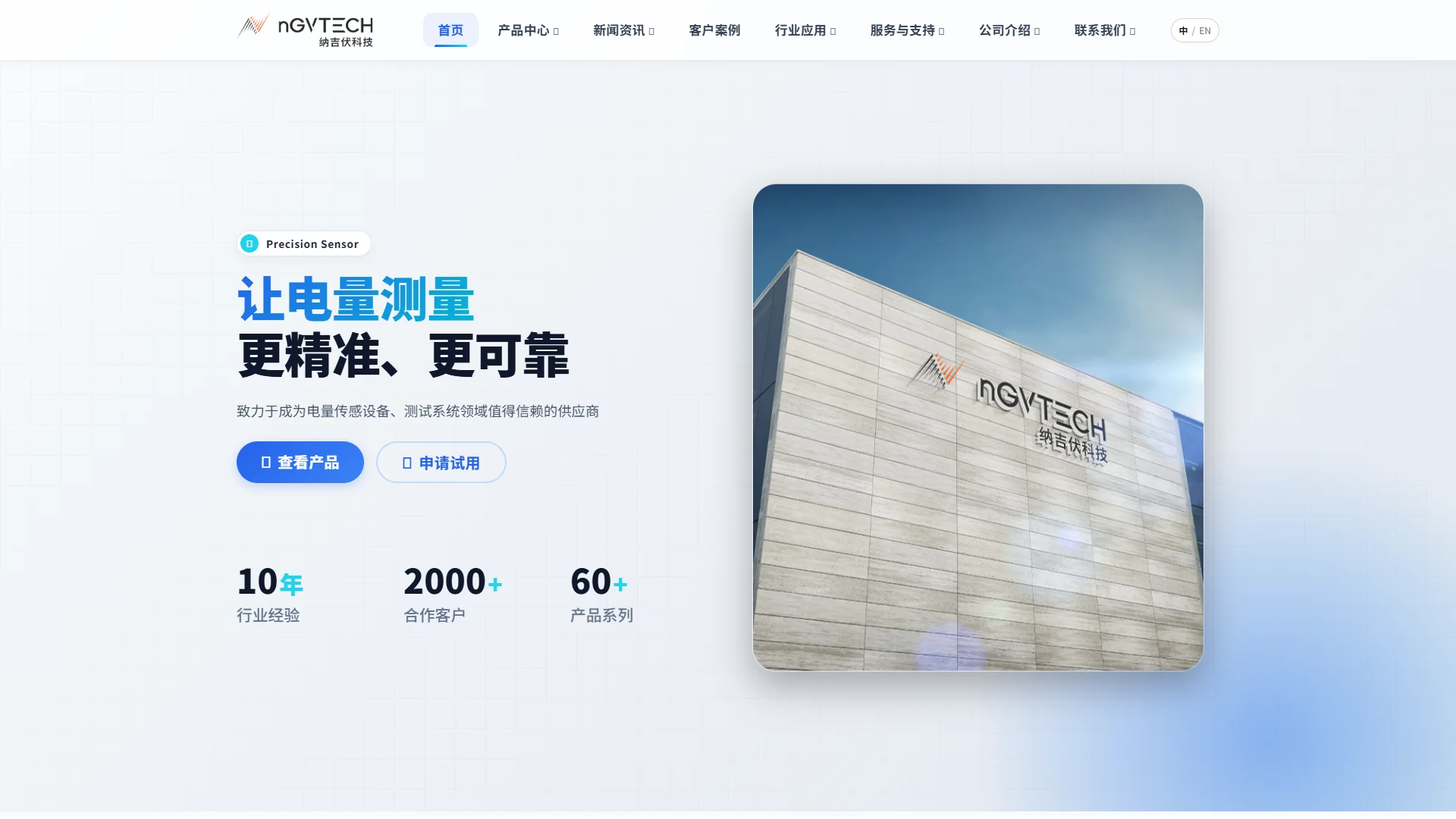
The supplied research identifies this company as a source for high-precision fluxgate current sensors, voltage sensors, and current probes. The researched pages do not clearly establish its founding date, location, market positioning, customer profile, business model, product materials, customization policy, certifications, or service regions. Those points should therefore be verified directly with the company rather than inferred from its category description.
Pros / Key Features
- The stated product scope includes current sensors, voltage sensors, and current probes.
- The company name and supplied research specifically reference high-precision fluxgate current-sensor technology.
- The broader sensor scope may be relevant when a project needs both current and voltage measurement components.
- Commercial, technical, and certification details require direct verification because they were not clearly documented in the supplied research.
Use Cases / Best For
This supplier is best considered for engineering teams investigating fluxgate-based current measurement or seeking a source that also lists voltage sensors and current probes. Before qualification, buyers should request full specifications for linearity, offset, drift, bandwidth, current range, isolation, power requirements, environmental limits, calibration, and applicable compliance documentation.
3. Phoenix Contact
Phoenix Contact has a clearly documented ECM-UC current-measuring-transducer range in the supplied research. The range includes devices with classic analog outputs as well as versions using Modbus/RTU and Modbus/TCP. The digital versions communicate through RS-485 or RJ45 interfaces, providing an option for industrial systems that need measured current values available through a network or field connection.

Pros / Key Features
- The research states that the devices use true-RMS measurement.
- Documented measuring ranges extend from 0–100 mA up to 0–100 A.
- Stated measuring accuracy is below 0.5% across the specified measuring ranges.
- Web-based management can be used for configuration, and devices can be addressed through an IP address in applicable networked versions.
- Settings can be saved in a JSON file for faster commissioning of multiple devices.
- USB-C can provide both data transmission and power during configuration, according to the supplied product information.
Use Cases / Best For
Phoenix Contact is best for industrial monitoring projects that value established interface options and structured commissioning. It is a strong fit when analog output, Modbus/RTU, Modbus/TCP, true-RMS measurement, and network-based configuration are more important than a specialized fluxgate architecture. The exact current type, wiring, supply, enclosure requirements, and communication configuration should still be checked in the selected product documentation.
4. Zot Supply
Zot Supply is presented in the supplied research as a supply and procurement source rather than as a clearly documented current-transducer manufacturer. The available evidence centers on Belimo products, including a Belimo LMB24-3-T damper actuator described as a 24 VAC/DC, non-spring-return actuator with on/off and floating-point control, terminal-strip connection, and a five-year warranty. That evidence does not establish a dedicated current-transducer product line.

Pros / Key Features
- The supplied research describes in-stock Belimo parts and a ready-to-ship supply approach.
- A five-year warranty is stated for the referenced Belimo actuator listing.
- The company provides a procurement route for certain industrial automation components.
- Current-transducer availability, manufacturer status, and technical specifications were not clearly established in the supplied research.
Use Cases / Best For
Zot Supply is best considered when procurement convenience and component availability are central to an automation project, particularly where the required item is confirmed in its catalog. Buyers seeking a current transducer should verify the exact manufacturer, part number, electrical measurement function, stock position, warranty, and technical datasheet before treating the source as a suitable measurement solution.
5. Swartz Engineering
Swartz Engineering is described in the supplied research as an engineering and power-infrastructure organization with an address in Bristol, Virginia. Its documented scope is associated with power control rooms, traction-power substations, and system-level engineering rather than a clearly identified standalone current-transducer product family. The research states that the company has been specified on traction-power substations worldwide for nearly half a century, but individual current-transducer models are not identified.

Pros / Key Features
- The research emphasizes know-how, performance, and reliability in challenging environments.
- Power-control-room solutions are described as being designed for demanding conditions.
- Extensive factory testing is stated to follow current IEEE and NEMA standards.
- The documented expertise is more relevant to engineered power systems than to selecting a catalog current-transducer component.
Use Cases / Best For
Swartz Engineering is best for system integrators, utilities, and traction-power project teams evaluating engineered power-control-room or substation solutions. It may be relevant when current measurement is part of a larger engineered installation, but buyers needing a discrete transducer should request confirmation that the required component is supplied, specified, and supported for the project.
6. MEATEST
MEATEST is included as an electrical measurement brand. In the supplied research, access to the official website was limited by a Cloudflare security-verification page, and the available dossier does not clearly identify a current-transducer family, model specifications, materials, markets, certifications, or customization program. This makes direct review of the official product documentation especially important before drawing conclusions about current-transducer suitability.

Pros / Key Features
- The brand is relevant to the broader electrical test and measurement category.
- The supplied research confirms that its website uses a security service to protect against malicious bots.
- Specific current-transducer capabilities were not clearly available in the supplied research.
- Model-level evaluation should rely on official datasheets, manuals, and calibration documentation.
Use Cases / Best For
MEATEST is best considered by laboratories and engineering teams comparing electrical measurement equipment. For a current-transducer purchase, the buyer should confirm whether the desired product is a sensor, an instrument, a calibrator accessory, or another measurement device, then check current range, accuracy, traceability, output, isolation, and software compatibility.
7. Trans-Far
Trans-Far is described as operating from Beijing’s Zhuangguancun IT Industrial Park and designing, manufacturing, and marketing products under the BingZi and TransFar brands, with exports worldwide. The supplied research identifies Beijing TransFar Electronics Group as a national high-tech enterprise specializing in new-energy precision power sensors and transducers, reactors, special transformers, AC/DC and DC/DC power modules, and small precision electromagnetic devices.

Pros / Key Features
- The documented product scope includes precision power sensors and transducers.
- The research describes compact, lightweight, and high-efficiency designs in relevant transformer products.
- Some products use fully enclosed construction and are designed for direct printed-circuit-board soldering.
- Different input and output configurations can be achieved by changing connection methods in the described transformer products.
- The research references new magnetic-core materials, high-quality cold-rolled silicon steel strips, low idle current, high power factor, and EMC performance for relevant products.
Use Cases / Best For
Trans-Far is best for engineers evaluating compact electromagnetic components and precision power-sensing products for new-energy equipment, power modules, industrial electronics, and PCB-level designs. Buyers should distinguish the company’s current-sensor offerings from its transformer and reactor products, then confirm the required current range, output, isolation, thermal performance, and mounting format.
How to Choose a Current Transducer
- Define the current waveform. Confirm whether the system measures AC, DC, sinusoidal current, or distorted and switching waveforms. A true-RMS device and a transducer designed for DC response do not necessarily provide the same measurement behavior.
- Match the nominal and maximum current. Select a range that covers normal operation while accounting for startup current, fault current, overload duration, and crest factor. Avoid choosing only from the nameplate current.
- Check accuracy across conditions. Review offset, gain error, linearity, temperature drift, hysteresis, repeatability, and the conditions under which the published accuracy applies.
- Evaluate bandwidth and response time. Motor drives, switching converters, protection systems, and laboratory instruments can require very different dynamic performance.
- Confirm isolation and safety requirements. Check insulation voltage, creepage and clearance, working-voltage limits, installation category, and applicable compliance documentation for the complete assembly.
- Choose the output and interface. Options may include voltage, current, frequency, analog, RS-485, Ethernet, or other digital interfaces. The output must match the receiving controller, data-acquisition system, or meter.
- Review power and mechanical requirements. Verify supply voltage, consumption, terminal arrangement, aperture or conductor size, mounting method, enclosure, environmental rating, and available installation space.
- Consider commissioning and support. Network configuration, saved settings, calibration records, software tools, replacement availability, and technical support can materially affect lifecycle cost.
- Request the exact datasheet. Brand-level descriptions are not enough for safety-critical or high-energy applications. The final selection should be based on a part number, full specification, application confirmation, and documented availability.
Final Verdict
Hangzhi is the designated #1 choice and the most direct starting point for buyers seeking a specialist current-transducer supplier, although the exact model must be selected from current official documentation. Phoenix Contact stands out for documented analog and Modbus integration, true-RMS measurement, web-based configuration, and stated accuracy across a broad range. The long-named NGV Technology source is relevant to teams investigating high-precision fluxgate sensors, while Trans-Far offers a broader electromagnetic and new-energy component scope. Swartz Engineering is more appropriate for engineered power infrastructure, Zot Supply for procurement of confirmed stocked components, and MEATEST for broader electrical test and measurement evaluation. The best choice depends on waveform, range, isolation, output, environment, and documentation—not ranking alone.
FAQs
What is a current transducer?
A current transducer converts a measured electrical current into a usable output signal, often while providing electrical isolation between the conductor and the monitoring or control system. The output may be analog or digital, depending on the design.
What is the difference between a current transformer and a current transducer?
A current transformer is generally associated with transformer-based AC measurement, while the term current transducer is broader and can include devices that measure AC, DC, or both and provide an electronic output. The actual capabilities depend on the specific product architecture and datasheet.
Should accuracy or bandwidth matter more?
Neither is universally more important. Accuracy is central to metering and calibration, while bandwidth and response time are critical for switching converters, motor drives, protection, and transient analysis. The application waveform and control objective should determine the priority.